Sunday, January 24, 2010

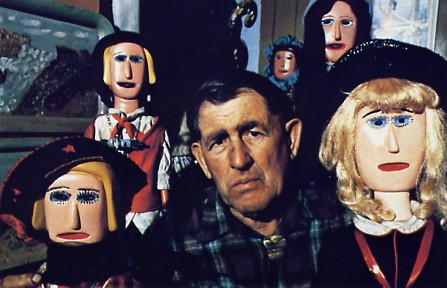
Artist: Calvin Black

Calvin Black was a folk artist who lived in California's Mojave Desert and created more than 80 life-size female dolls, each with its own personality, function, and costume. He also built the "Bird Cage Theater," where the dolls perform and sing in voices recorded by the artist.
Go through the questions, #1 through #7. Turn in the answers AND your print-outs at the end of class.

1. Click here to see a figure made by:

Lynn Barges in 1960. It is called "Pair of Scarecrows".


2. Click here to see a concrete figurative sculpture called "Bottle Man".


3. Click here to see wood sculptures called "Boxers Whirlgig".


4. Click here to see sculptures by Jack Earl.


5. Choose one of these figurative sculptures you like the most.

A. What is the artist's name?

B. How do you think the artist made this sculpture?

C. What do you like or not like about this sculpture?


6. Go to http://www.googleimages.com/ OR find your favorite clothing website. Now FIND AN OUTFIT for the figure you are making in class. Is your figure going to be dressed in formal wear (like for prom?) OR casual weekend clothes OR clubbing/dancing clothes? What's clothing fits your personality? Print out the outfit!

7. Make an avatar! Choose any site from the websites below. Make a "YOU" on the computer!

http://www.osoq.com/edit-pictures-online/make-your-avatar.asp
http://www.lianasims2.net/


Tuesday, May 5, 2009

Sculptures inspired by Keith Haring

Martin, "...I would like to show people that it is not hard to go far with a car, baby, and a dog...you just have to work hard."


Remember when we viewed artwork by Keith Haring?

These sculptures are freestanding. They are sculptures in the round. Each sculpture communicates a message to the viewer and the artists repeat an element to create a unified artwork.

Look at some of the sculptures created by Art One students. Read a portion of the artist's statement to learn more about each artist's intention and message.


Venus "My Life"

Monday, May 4, 2009


Mayra "Love For My Puppy"


Daisy "Personal Me"

Tuesday, December 2, 2008

Creating a Self Portrait


In Art 1 class, we are currently creating realistic self portraits with value. We are using ebony pencils to create high contrast pencil drawings. To get a realistic representation of ourselves, we are using a photograph broken up into small squares. This grid process, which integrates math skills, will help us create accurate drawings to look like us!


Computer Lab work on Tuesday, December 2
Directions: Write the answers to the questions below in your drawing packet/sheet.
Open a new window (CTRL-N) to navigate between this website and other sites.

1. Look at the 2 self portraits below. The one on the left is "Colour Me Blue" by Alpana Vij. The self portrait on the right was created by Ian Granberg.
Which portrait is more realistic? Why is it realistic? Which portrait is meant to be more expressive and is not as realistic? What makes you think that?

Monday, December 1, 2008

2. What is a self portrait? What is a portrait?

3. Before cameras and photography were invented, artists would create self portraits and portraits to capture what a person looks like. Rembrandt van Rijn was discovered to have created more than 90 paintings of himself in the 1600's.
Look at his self portrait paintings here.
Click on one of his self portrait paintings and make it larger. Write 3 sentences to describe this self portrait.

4. Artists have always had practical reasons for making self-portraits. Read below.
A. They get a model who is always available and works for free!
B. Self portraits are a good way for an artist to practice rendering different expressions and moods.
C. Self-portraits may also represent an artist’s quest for immortality--as a way to leave behind an image that will outlive the artist.
D. Self portraits can preserve a memory, serve as a gift, and even help an artist further understand him/herself.
(If you read A-D, you don't have to answer anything! Just read them)

5. A facial expression is a way a person can communicate a message without words. Look at the facial expressions below. Pretend each person is A, B, C, D, E, and F. What feeling does each person show?